








Key takeaways
- Start by clearing counters, since visible surface space shapes how large a small kitchen feels day to day.
- Drawer dividers, tiered shelf risers and pull-out baskets recover the hidden depth inside cabinets you already own.
- Clear, labelled containers keep pantry staples visible and stop duplicate purchases piling up.
- Vertical and wall-mounted storage frees the counter and puts everyday tools within easy reach.
- You can make real progress with a few affordable organisers rather than a full kitchen renovation.
The fastest way to organize a small kitchen is to clear the counters first, then use the hidden depth inside your cabinets and the empty space on your walls. You do not need to knock down a wall or buy a new set of units. A handful of well-placed organisers, a little sorting and a few simple habits usually make a compact kitchen feel calmer and far easier to cook in.
Many of us in Lebanon live with kitchens that are on the smaller side, especially in apartments. The good news is that small kitchen organization ideas work best when they are simple and repeatable, so the tips below focus on changes you can make this week.
Why small kitchens feel so crowded
A crowded kitchen is often less about square footage and more about where things sit. In a national survey of 2,000 adults, about 32% of people said their home's clutter came from the space being too small for the amount of stuff they need. That feeling is familiar to anyone working around a compact counter and a couple of cabinets.
For context, the National Kitchen and Bath Association found that kitchens average around 161 square feet, and many homes come in well under that. When space is tight, every shelf and drawer has to earn its place. That is where a little planning pays off.
Maximizing cabinet and drawer space
Cabinets usually hold more than they appear to, because most of the vertical space inside a shelf sits empty above your plates and bowls.
A few changes recover that room:
- Shelf risers add a second level inside a cabinet, so cups can sit above plates instead of beside them.
- Stackable storage keeps containers and their lids together and stable, rather than sliding around loose.
- Pull-out baskets let you reach items at the back of a deep cabinet without unpacking everything in front.
Drawers respond well to dividers. A set of adjustable dividers turns one jumbled drawer into tidy lanes for cutlery, utensils and small tools. When each item has a lane, you spend less time digging and the drawer closes smoothly every time.
If your lower cabinets are deep and hard to reach, group items into labelled bins by type, such as baking, cleaning or lunchboxes. You then pull out the whole bin, take what you need and slide it back.
Smart containers and racks for pantry order
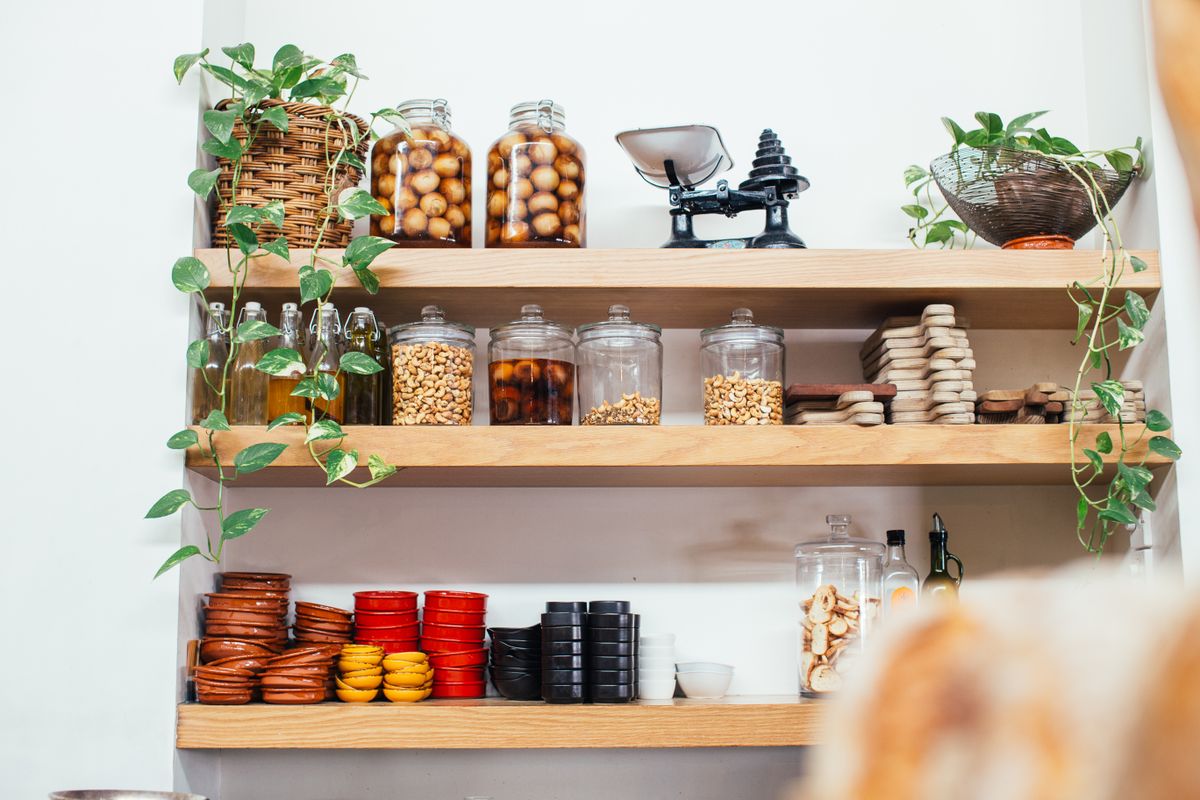
A tidy pantry saves money as well as space. When you can see your staples at a glance, you are less likely to buy a second bag of rice or another jar of spice you already have.
Clear, airtight containers work well for dry goods like flour, sugar, pasta, lentils and coffee. They stack neatly, keep contents fresh and let you spot when something is running low. Uniform shapes also fit together far better than a shelf of mismatched original packaging.
A few practical habits help:
- Decant repeat staples into matching containers so shelves line up cleanly.
- Label everything, including a note of any cooking instructions from the original pack.
- Add a small rack or riser at the back of the shelf so tins and jars behind the front row stay visible.
Our storage and organisation collection includes containers and racks in a range of sizes, which makes it easier to match a set to the depth of your shelves.
Countertop declutter tricks
Clear counters are the single change that makes the biggest visual difference in a small kitchen. Open surface space gives you room to actually prepare food and makes the whole room feel lighter.
Try these steps:
- Keep only daily tools out. If you use the kettle every morning, it earns its spot. The blender you reach for once a month can live in a cabinet.
- Corral small items such as oils, salt and cooking spoons on a single tray or in a slim caddy. One object to wipe around beats ten.
- Move appliances you rarely use off the counter entirely, and store them with their cables tucked in a bin.
A tidy counter is also easier to clean, which matters day to day. A small kitchen is one of the easiest places to feel that benefit quickly, since a single clear surface changes how the whole room feels.
Vertical storage and wall-mounted solutions
When the floor plan is fixed, the walls are your best friend. Vertical storage moves everyday items off the counter and keeps them within easy reach.
Options that suit compact kitchens:
- Wall-mounted rails and hooks hold mugs, utensils and light pans, freeing drawer and counter space.
- A narrow shelf above the counter gives spices and small jars a home without blocking your work area.
- Over-the-door racks on a pantry or cabinet door turn wasted space into storage for foil, wraps and cleaning supplies.
- Tension rods inside a cabinet can separate baking trays and chopping boards so they stand upright.
If you rent and cannot drill, adhesive hooks, freestanding rails and tension rods give you the same lift without marking the walls. Just check the weight guidance on adhesive fittings and keep heavier items on fixed supports.
Habits that keep a small kitchen tidy
Organisers do the heavy lifting, but a few small habits keep the results in place.
- Put things back in the same spot. When every item has a home, tidying takes seconds instead of a weekend.
- Do a quick reset each evening. Clearing the counter and washing the last few items before bed means you start the next day with a clean surface.
- Review a shelf every month. Move anything you never use out of prime storage, and pass on duplicates you have collected.
These habits suit busy households and shared kitchens, where several people use the same small space. The clearer the system, the easier it is for everyone to keep to.
Small kitchen organization ideas on a budget
You do not need to buy everything at once. Start with the change that annoys you most, then add pieces over time.
A simple starter set for most small kitchens looks like this:
- One set of drawer dividers for cutlery and utensils.
- A few clear containers for your most-used dry staples.
- One or two shelf risers to double up cabinet space.
- A small rack or a set of hooks for the wall.
You can find each of these across our home essentials and storage range, with sizes to suit shallow shelves and deeper cabinets alike. Buying a couple of pieces at a time keeps the cost manageable and lets you see what genuinely helps in your own kitchen before you add more.
The aim is not a picture-perfect kitchen. It is a space where the things you use every day are easy to find and easy to put back, so cooking feels lighter even when the room is small.
If you would like to start with one area, take a look at our storage and organisation collection and pick the piece that solves your biggest daily frustration first.
Frequently asked questions
Where should I start organizing a small kitchen?
Begin with the countertops. Clearing surfaces gives you an immediate sense of more space and makes it easier to see what you actually use, so you can decide what deserves prime storage.
How do I make more room in small kitchen cabinets?
Add shelf risers to create a second level, use stackable containers, and fit pull-out baskets or drawer dividers so you can reach items at the back without unpacking the whole shelf.
Are wall-mounted storage solutions worth it in a rented home?
Yes. Adhesive hooks, tension rods and freestanding rails give you vertical storage without drilling, which suits renters who cannot make permanent changes.
Do I need expensive products to organize a small kitchen?
No. A few well-chosen organisers such as dividers, jars and a small rack make a clear difference, and you can add more over time as your budget allows.


